PATRON · by MateMatic Solutions
A local AI platform for lawyers
Case-file analysis, legal research and document work - with source verification, an audit trail and human oversight. PATRON runs locally, on your own hardware. Open source.
Open source (AGPL-3.0) · Local-first · Learns with you · Audit trail
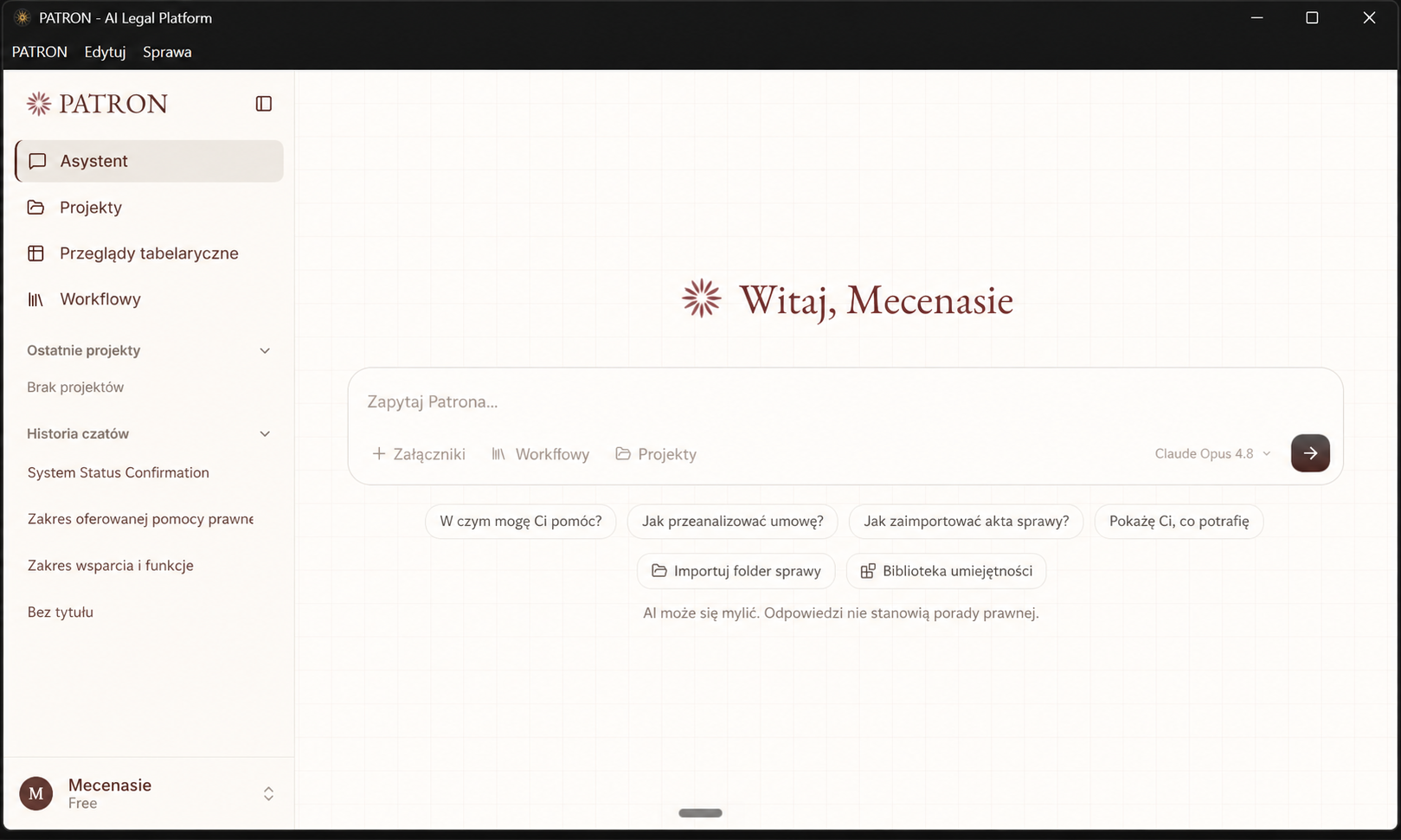
Three things that keep a lawyer away from AI
Not a lack of will. A lack of trust. PATRON is built around the three fears we hear most often in law firms - and around an answer to each.
AI invents with a confident face
ProblemThe model writes falsehoods in an expert's tone. You sign off on it, not the model.
PATRONEvery claim drawn from the file gets a footnote to a verbatim quote and a page number. What isn't in the document, it doesn't invent.
Case files in someone else's cloud
ProblemUploading a case folder to an external service raises a professional-secrecy question.
PATRONIt runs locally, on your computer. Sensitive matters need never leave the machine at all.
A black box
ProblemYou have an answer, but not where it came from or how to defend it.
PATRONIt shows the source of every claim and records an audit trail you can check without having to trust us.
Quote, paraphrase, no basis
This is the heart of PATRON. When it relies on a document, it attaches a footnote to the source. You click the quote and see the verbatim passage with its page number - before you build a filing on it. What isn't in the file, it doesn't invent.
Hover over a footnote to see what PATRON shows beneath each one
The court found the clause unfair1QuoteContract, p. 14Passage found in the file word for word. Illustrative example., and the doctrine concurs2ParaphrasePATRON's summaryFaithfully rendered, but not a quote. Verify before relying on it.. The claim that the entire contract is void3No basisNot in the filePATRON flags it and does not pass it on. has no basis in the file.
The passage exists in the document word for word. You click the footnote, see it with its page number, and paste it into your filing.
When PATRON summarises or draws on general knowledge, it sets that apart from the file's content. Check it before you cite.
What it can't find in the document, it doesn't invent. It says plainly that there is no basis for it in the file.
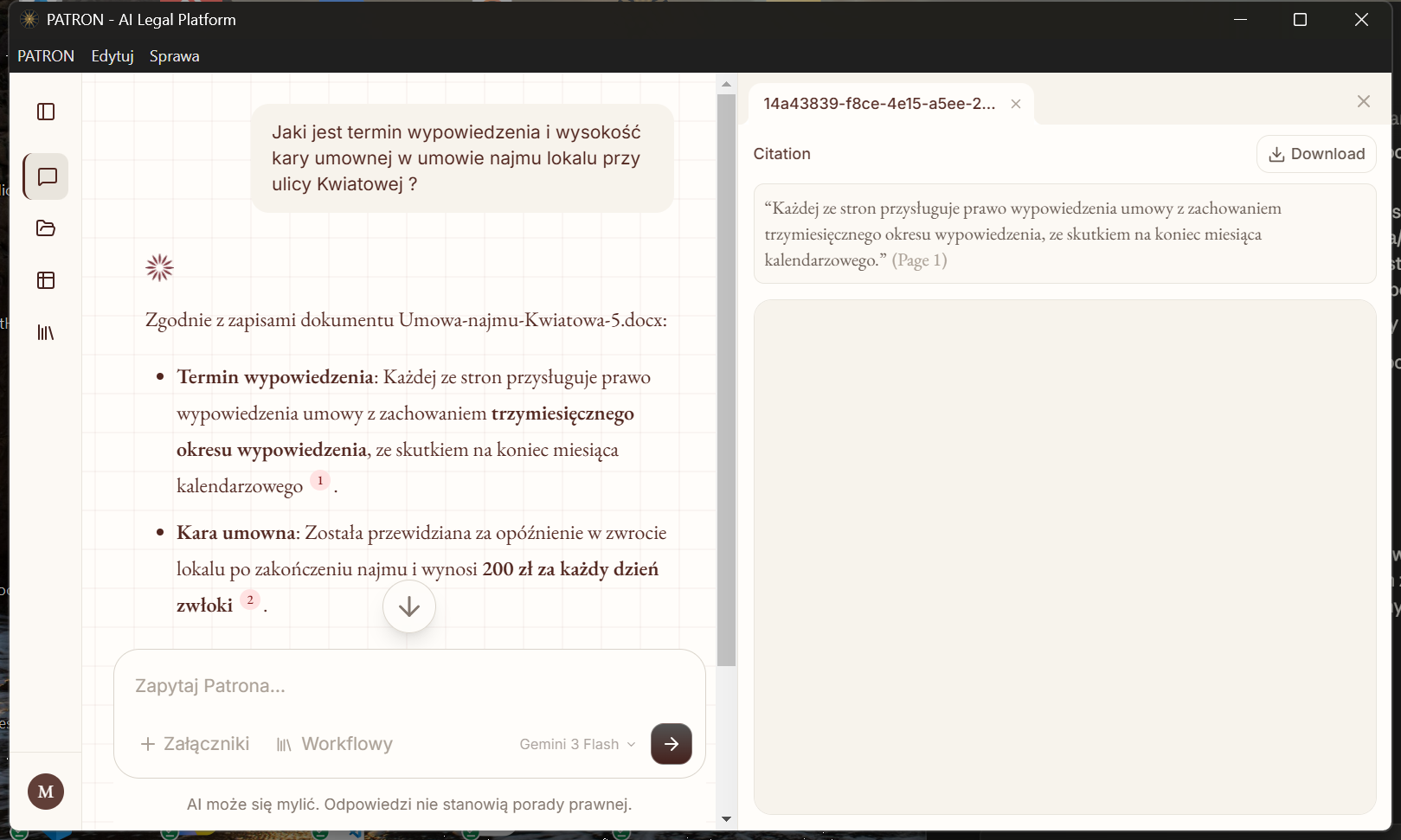
The mechanism supports verification; it does not replace the lawyer's judgment.
The whole matter at once, not a dozen notebooks
Large matters don't fit into cloud tools. You cut the folder into pieces, spread it across several notebooks and lose the context between them. PATRON keeps it in one piece - thousands of documents in a single Matter.
It runs locally, so the limit is your disk and memory, not an account quota. A six-hundred-page scan goes in whole, without trimming.
The stronger the hardware, the larger the matter. Scale grows with your machine.
- The whole case file in one Matter
- Thousands of documents at once
- No file-size limit
- The limit is your hardware, not a price tier
All your case-file work in one place
From a question to the folder, through field extraction, to your choice of model. Each feature kills a specific daily pain in the firm.
Assistant - chat with the file
ProblemA question to a six-hundred-page folder means hours of reading.
SolutionYou ask in plain language and get an answer with a quote and a page number.
Matters - the case file as context
ProblemCase documents scattered across drives, emails and scans.
SolutionOne Matter holds the complete file of one case. You import a folder in one move; PATRON keeps everything in context.
Table view
ProblemCopying dates, amounts and penalties from dozens of contracts into Excel.
SolutionPATRON extracts fields from many documents into one table. Each cell links back to its source; export to Excel.
Import and OCR - every format in the folder
ProblemA scan or phone photo is a dead image, not searchable text.
SolutionIt reads PDF, DOCX, DOC, scans and photos (OCR) - from a court letter to a snapshot of a document. It indexes the whole folder for search.
Pseudonymisation and input scan
ProblemSensitive data shouldn't reach the model uncontrolled.
SolutionPersonal-ID numbers and names pass through pseudonymisation; documents pass a security scan before the model.
Models - bring your own
ProblemA single AI provider means lock-in and a question of where the data lands.
SolutionYou connect your own model: Claude, Gemini, a local Ollama or OpenRouter. Sensitive matters stay fully offline.
Six features above. The full catalogue: 28 capabilities, each with a problem, a solution and a link to the architecture decision behind it.
It learns with you - the firm's second brain
Every matter starts from zero, and knowledge leaks away into emails and people's heads. PATRON builds a local memory that grows with your practice - it remembers documents, matters and the links between them. Like a personal Obsidian, except it understands case files.
Underneath, three layers work: vector search (RAG) over your documents, a local SQLite database for matters and decisions, and a knowledge graph linking parties, matters and sources. The longer you work together, the more context it has at hand.
All local, on your own hardware. The graph grows under supervision - a human approves the links within it.
- Vector search (RAG) over your files
- Local SQLite database: matters, documents, decisions
- Knowledge graph: parties, matters, sources and links
- It grows with every matter - and stays with you
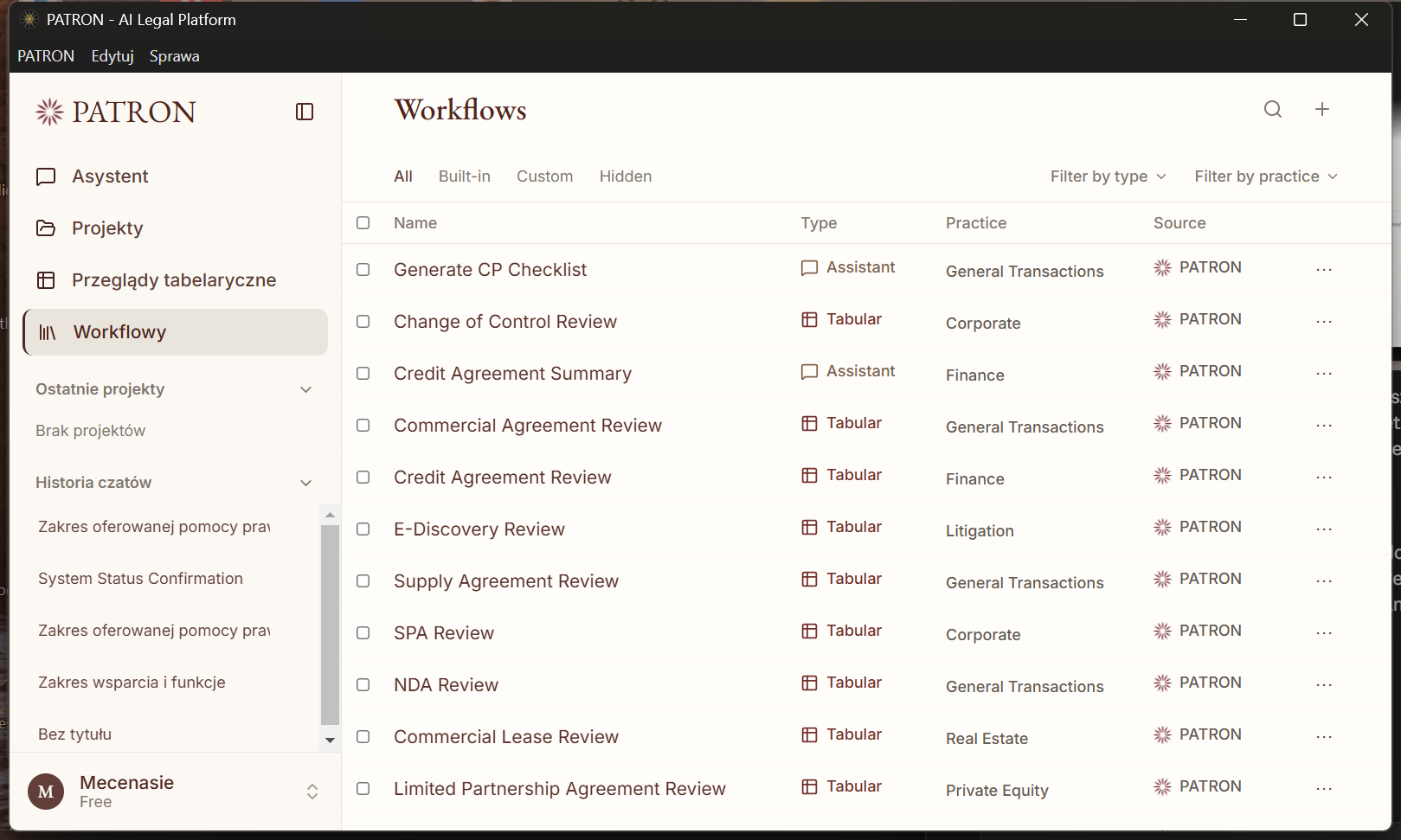
Build the procedure once, then one click
The same lease-agreement review comes back every week, and every time you click through it from scratch. You save the sequence of steps as a workflow and run it on each new matter.
Set up a first-pass contract review once, then one click on a new folder.
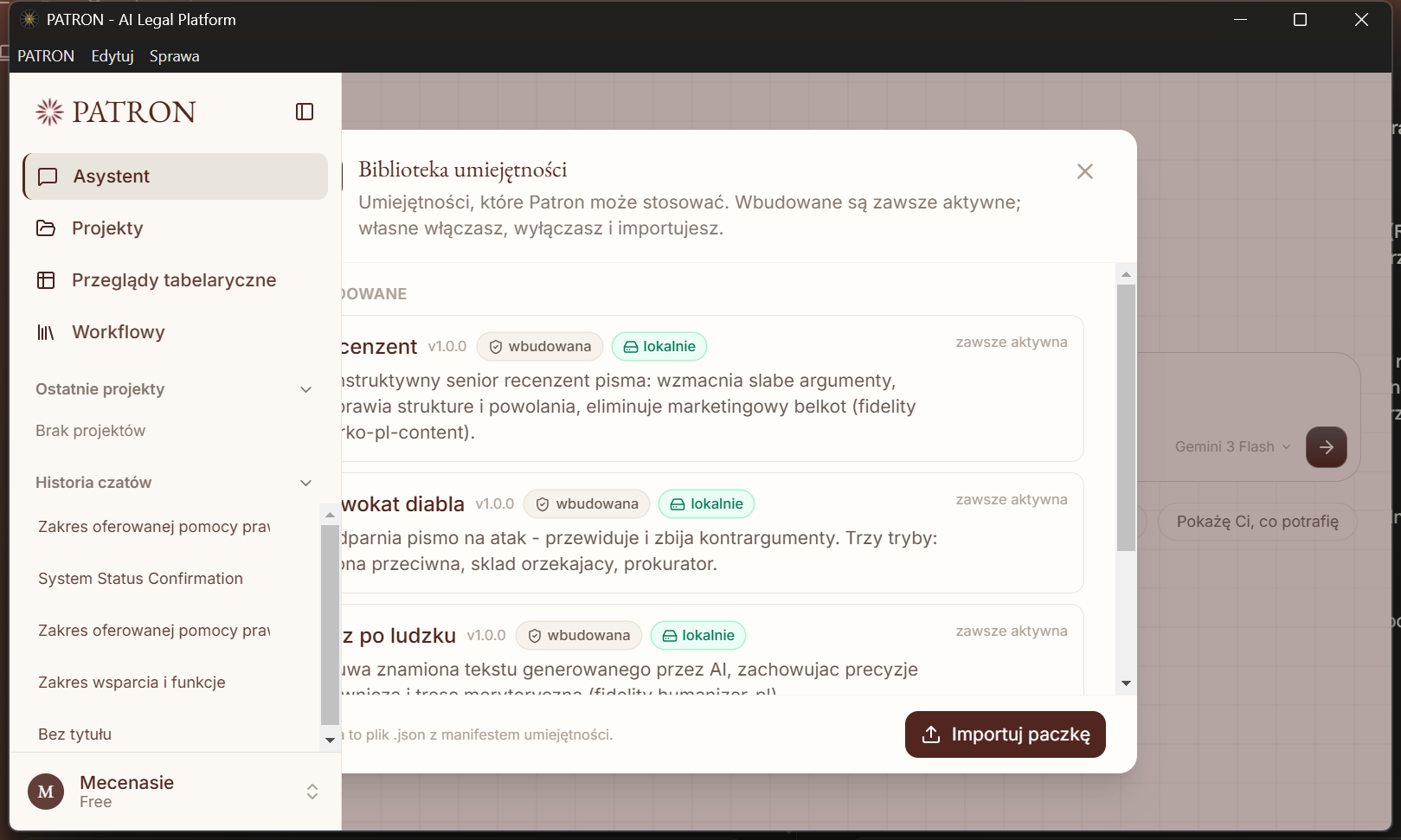
Ready-made skills out of the box
Starting from a blank page is the same fight over wording every time. PATRON ships with built-in skills - a document reviewer, a devil's advocate, an editor - always on, locally. You start from a tested one and adapt it to your practice.
Add more skills from the MateMatic Boutique catalogue, one file at a time.
Polish and EU legal sources, mid-answer
Searching across six open tabs means copy-pasting and losing citations. Seven MCP connectors (open, MIT-licensed) link PATRON to authoritative sources - it reaches into them while answering.
SAOS
Common, Supreme and Constitutional Court rulings, plus the National Appeals Chamber.
NSA
Administrative courts (Supreme + 16 regional, CBOSA).
ISAP
Statutes and acts (Journal of Laws + M.P., Sejm ELI).
KRS
Company register: relationships, governing bodies, shareholders.
EUR-Lex / CJEU
EU law and Court of Justice case law (live SPARQL).
EU-Compliance
GDPR, AI Act, DORA, NIS2, eIDAS 2.0, CRA.
EUREKA
Polish tax rulings: KIS interpretations, WIS and WIA (Ministry of Finance). The authorities' practice, not a source of law.
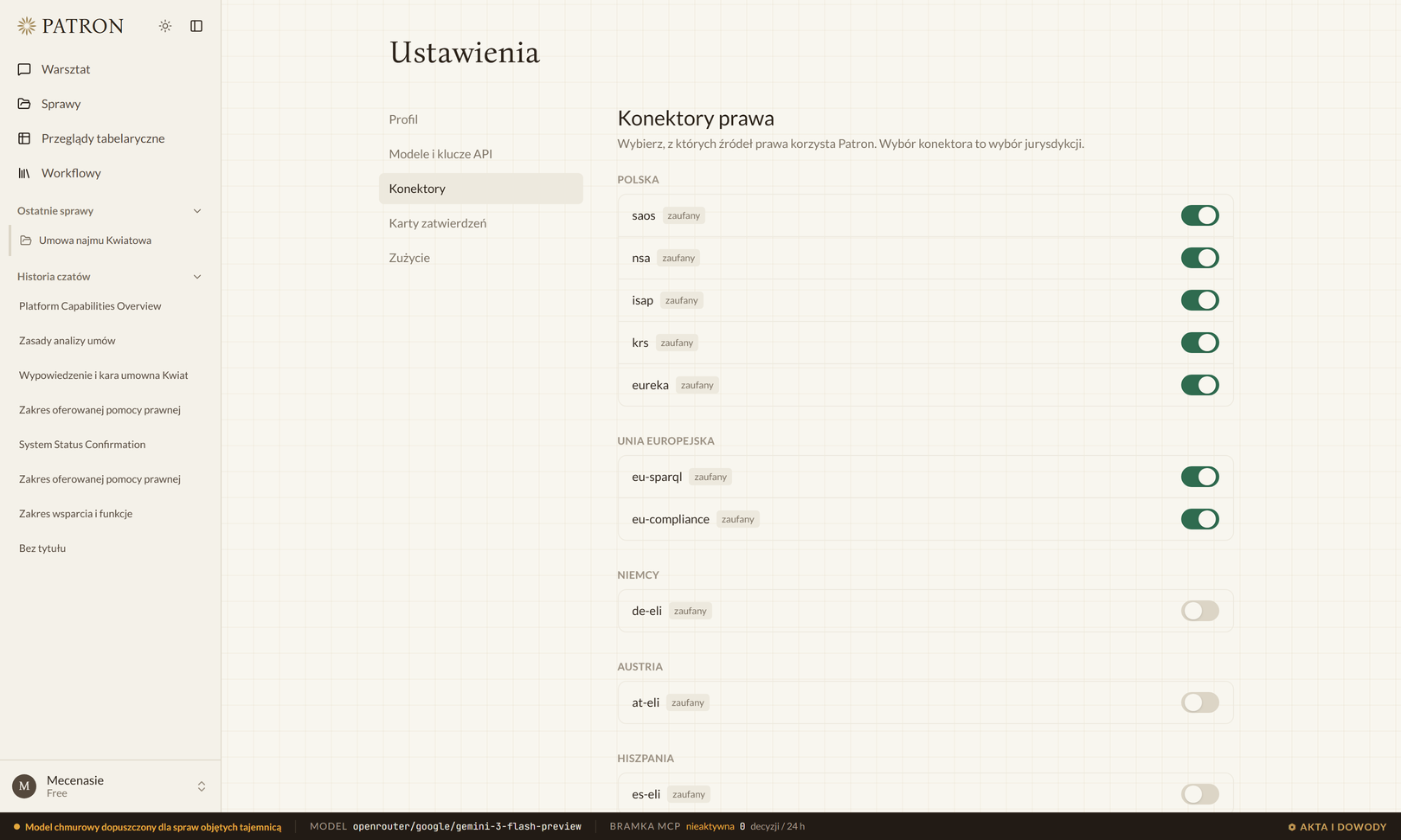
You switch on only the sources you want to work from. Choosing a connector is choosing a jurisdiction.
You can also search Polish and EU law without installing anything: Repertorium runs in the browser and over MCP, independently of PATRON.
A log you can check, not one you have to believe
Compliance asks "how did this answer come about", and all you have is a chat thread. PATRON records every interaction with the model in a hash-chain, with a Merkle tree above it. An auditor verifies consistency offline, without trusting us and without access to the content.
You export an audit package: who, when, with which model, on which source. It documents how AI was used on the matter, and where a deployment falls under the high-risk obligations it also serves the record-keeping duty in AI Act art. 12.
Full audit trail documentation and the release history: how the chain is built, the Merkle tree, three verification paths, mapping to EU AI Act article 12 and an explicit list of limits.
MateMatic's reading of the AI Act / GDPR, not a position of the Polish bar associations.
- The question, the model and the run parameters
- The sources the answer relied on
- A hash of each event, chained together
- A Merkle tree over the chain
- Offline verification, independent of MateMatic
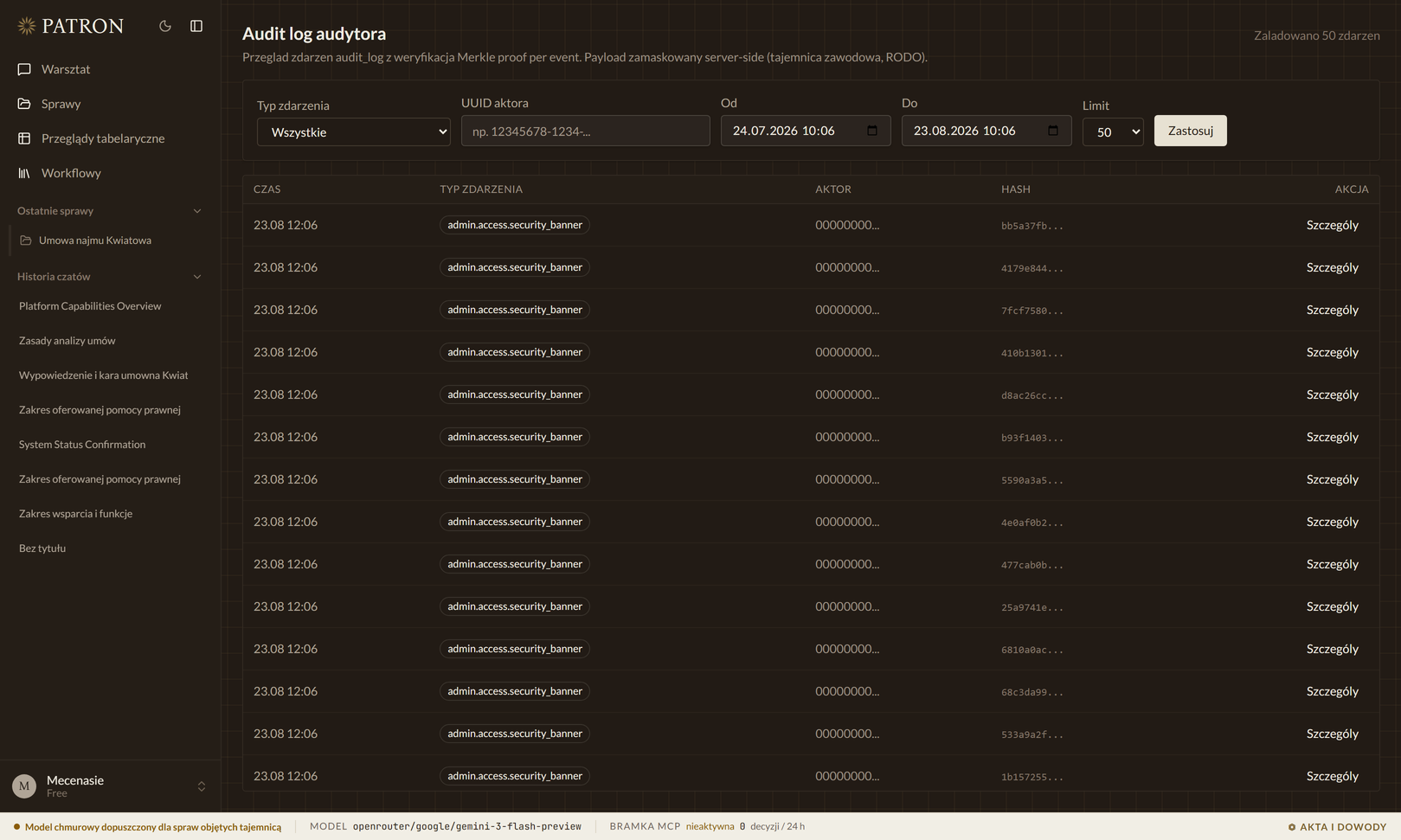
The same interface reversed. PATRON's two themes are one pair of pigments with the roles swapped.
PATRON vs cloud legal AI
The difference is architectural, not cosmetic. Where the case files live decides what a firm can promise its client.
| PATRON | Typical cloud legal AI | |
|---|---|---|
| Where data lives | The firm's own hardware (local-first) | The vendor's cloud |
| Sensitive matters | Can run fully offline on a local model | Sent to the provider |
| Source verification | Quote / paraphrase / no-basis, per claim, with page number | Varies; often unattributed |
| Audit trail | Hash-chain + Merkle tree, verifiable offline | Vendor-controlled, where present |
| Licence | Open source (AGPL-3.0) | Proprietary |
| Jurisdiction | 7 Polish & EU legal-source connectors built in | General-purpose |
"Typical cloud legal AI" describes a common architecture, not any single named product. Compare against your chosen vendor's current terms.
Questions lawyers ask first
Is PATRON a European alternative to Harvey?
PATRON is a European, local-first take on legal AI. Where cloud platforms such as Harvey, Legora and others process a firm's documents on their own servers, PATRON runs on the firm's own hardware - case files need never leave the building - and it shows the source behind every claim. Different architecture, same goal: legal AI a firm can actually defend.
Is PATRON GDPR-safe?
PATRON is built local-first, so personal data can stay inside the firm. Sensitive matters can run on a local model (Ollama) fully offline, and personal-ID numbers and names pass through pseudonymisation before any model sees them. This is MateMatic's reading of GDPR and the EU AI Act, not a position of the Polish bar associations.
What is local AI for law firms?
Local AI runs the model and your documents on your own hardware instead of a vendor's cloud. For a law firm that means case files don't leave the office, professional secrecy becomes a property of the architecture rather than a promise, and the work can run fully offline. PATRON is built this way: with a local model nothing leaves the computer, and a cloud model runs only if the firm chooses one.
Will the AI make up something I have to sign off on?
PATRON attaches to every claim drawn from the file a footnote to a verbatim quote and a page number. What isn't in the document, it doesn't invent - and where there is no basis in the file, it says so plainly.
Do the firm's case files go to someone else's cloud?
Only if the firm decides so. Documents and the index stay on the lawyer's computer. With a local model (Ollama) nothing leaves the machine and you can work fully offline. If you choose a cloud model and enter your own provider key, the passages needed for an answer go to that provider: PATRON first replaces recognised personal data with pseudonyms and records every such transfer in the audit trail.
How large a matter can PATRON handle?
The software sets no ceiling: thousands of documents in a single Matter, with no file-size limit. Because it runs locally, the limit is your hardware, not an account quota; a six-hundred-page scan goes in whole.
Does PATRON lock me into one AI provider?
No. PATRON is bring-your-own-model: you connect your own model - Claude, Gemini, a local Ollama or OpenRouter. Sensitive matters can stay fully offline.
What does PATRON cost and what does it run on?
PATRON is free (open source, AGPL-3.0 licence) and runs on Windows. The code is on GitHub.
MateMatic Boutique - skills you can download
PATRON is the platform. Skills are what it runs on: ready-made abilities it applies to your own documents. Boutique is a curated catalogue of legal skills. You download a file, install it with a simple wizard, and the firm has a new ability at its disposal.
They are free to begin with, because we would rather build the library and earn trust before we price anything. Some will become premium later, always with honest credit for authorship and licensing.
Download it, or talk to us about deployment
PATRON is free and open. MateMatic handles deployment, configuration and training.